
Accident reconstruction rarely comes down to a single analysis technique. We build our opinions by reviewing photographs, performing vehicle inspections, analyzing Event Data Recorder (EDR) data, considering physical evidence, performing crash simulations, and sometimes conducting testing.
One tool I have found increasingly useful is comparison with real-world crashes from NHTSA’s Crash Investigation Sampling System (CISS).
The basic idea is simple: find documented crashes involving vehicles and impact orientations comparable to the incident, then compare the documented CISS Delta-V to the incident crash. I generally try to stay within the incident vehicle’s sister-year range so that the comparison vehicle is substantially similar to the incident vehicle.
This can be a powerful demonstrative tool as juries respond well to visual comparisons. Showing photographs of documented real-world crashes alongside the incident vehicle can make an impact severity analysis much easier to understand (Figure 1).
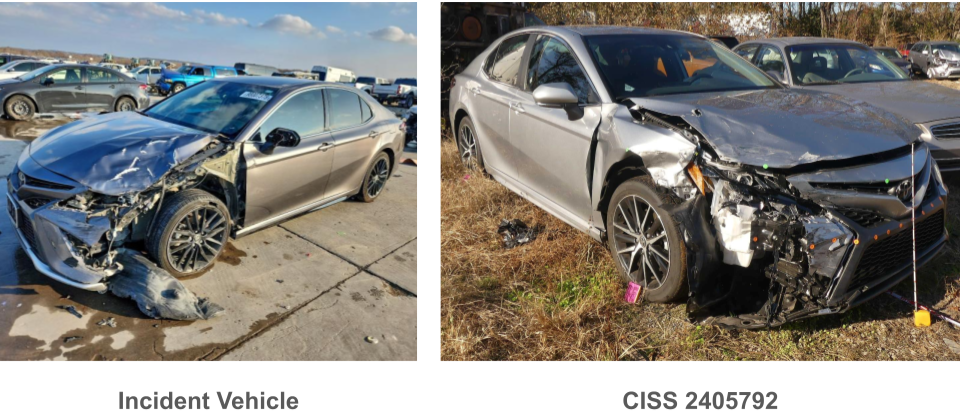
Figure 1: Comparison between the incident vehicle and CISS Case 2405792.
Oftentimes, rather than looking for one “perfect” comparison, I find it useful to establish a range. I may classify CISS crashes as lower-severity, similar-severity, and higher-severity. This can help bound the severity of the subject collision. For example, I might place an impact severity somewhere between 12 and 16 mph.
From NASS to CISS
Before CISS, I regularly searched its predecessor, the National Automotive Sampling System Crashworthiness Data System (NASS-CDS).
NASS remains a useful historical resource, but its age creates limitations. EDR technology was still being introduced across manufacturers during much of the NASS era, so many older cases simply don’t contain the type of EDR information available from newer vehicles.
Even when crash pulse information was available, older EDRs commonly recorded only longitudinal speed change. For impacts with a substantial lateral component, the missing lateral information could be significantly limiting.
CISS began collecting cases in 2016 as the modern replacement for NASS-CDS. As the vehicle fleet has naturally turned over, the percentage of vehicles equipped with EDRs has grown as well. As a result, newer CISS cases are increasingly likely to contain useful EDR data.
For accident reconstructionists, that makes the CISS dataset more useful with each passing year.
CISS Is Getting Bigger
CISS is also in the middle of a significant expansion. I previously wrote about this expansion in my LinkedIn post in September.
Beginning in 2024, NHTSA started expanding the program beyond its previous 32 Sampling Sites. The planned expansion increases CISS to 73 sites by 2028 while also broadening the types of crashes included in the program.
That expansion includes non-motorists beginning in 2024, motorcycles beginning in 2025, and heavy trucks beginning in 2026.
CISS also includes collisions involving fixed objects, which opens another useful category of crash test searches. Vehicle-to-pole, tree, barrier, and other fixed-object impacts can also be highly useful.
Wading Through a Sea of Data
NHTSA provides an invaluable public resource by collecting and publishing this information. The challenge is that more incoming data also means more data to review.
For someone working a full caseload, the limiting factor can quickly become time rather than the availability of data.
That problem is ultimately what led me to build Crashybara.
Crashybara doesn’t replace the underlying NHTSA data or the engineering judgment required to interpret it. It is essentially a faster way to search, filter, review, and export CISS data.
You can spend less time hunting for potentially relevant crashes and more time evaluating them. The Crashybara interface allows you to quickly review relevant photos of each vehicle, review the impact severity as coded by NHTSA technicians, and review the EDR report for validation (Figure 2). The data can then be exported to a convenient PowerPoint format for completing your severity analysis, as well as to an Excel spreadsheet that includes curb weights. Crashybara contains only EDR-enabled impacts and intentionally excludes SMASH delta-V estimations.
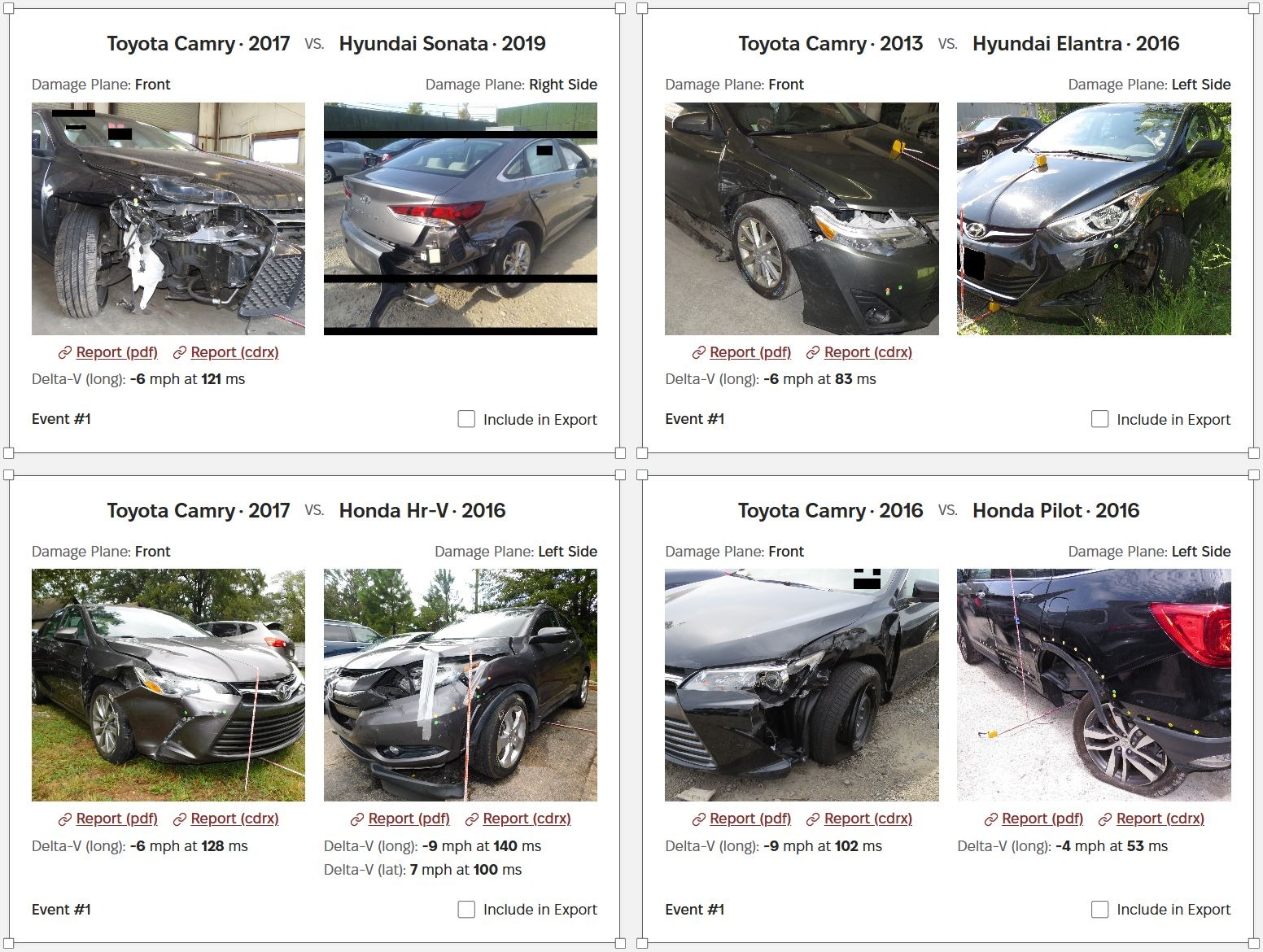
Figure 2: The Crashybara interface.
Searching Both Vehicles
One capability I’ve found especially useful is searching database variables of both vehicles involved in a collision, something that isn’t available through the standard CISS search interface.
If I’m analyzing a vehicle-to-vehicle collision, I may care not only about the target vehicle, but also about the vehicle that struck it. Was it a pickup truck, passenger car, SUV, or van? Where did that vehicle make contact? How closely does that collision orientation resemble the incident I’m analyzing?
Being able to filter both Vehicle 1 and Vehicle 2 variables makes it possible to get far more picky with the analysis.
For now, this works particularly well with popular North American vehicles. Manufacturers such as Toyota, Chevrolet, and Ford are absolutely flush with results, which provides enough cases to begin adding increasingly specific search criteria while still having ample results.
I think there is considerable room to take this concept further.
As the dataset grows, machine learning and computer vision may eventually make it possible to search for characteristics visible in CISS photographs, even when they aren’t explicitly coded in the underlying database.
Does the striking vehicle have a trailer hitch? An aftermarket bumper? A brush guard? A bike rack?
Those aren’t necessarily searchable variables today, but much of that information is already sitting there in the photographs. I plan to explore incorporating these types of capabilities into Crashybara in the future.
Where I Think This Is Going
The relevance of CISS to accident reconstruction is growing every year.
Two things are happening simultaneously: older vehicles are gradually being retired and replaced by vehicles with more capable EDRs, while CISS itself is dramatically expanding its data collection. Figure 3 shows the growth in EDR-enabled impacts being added to CISS annually.
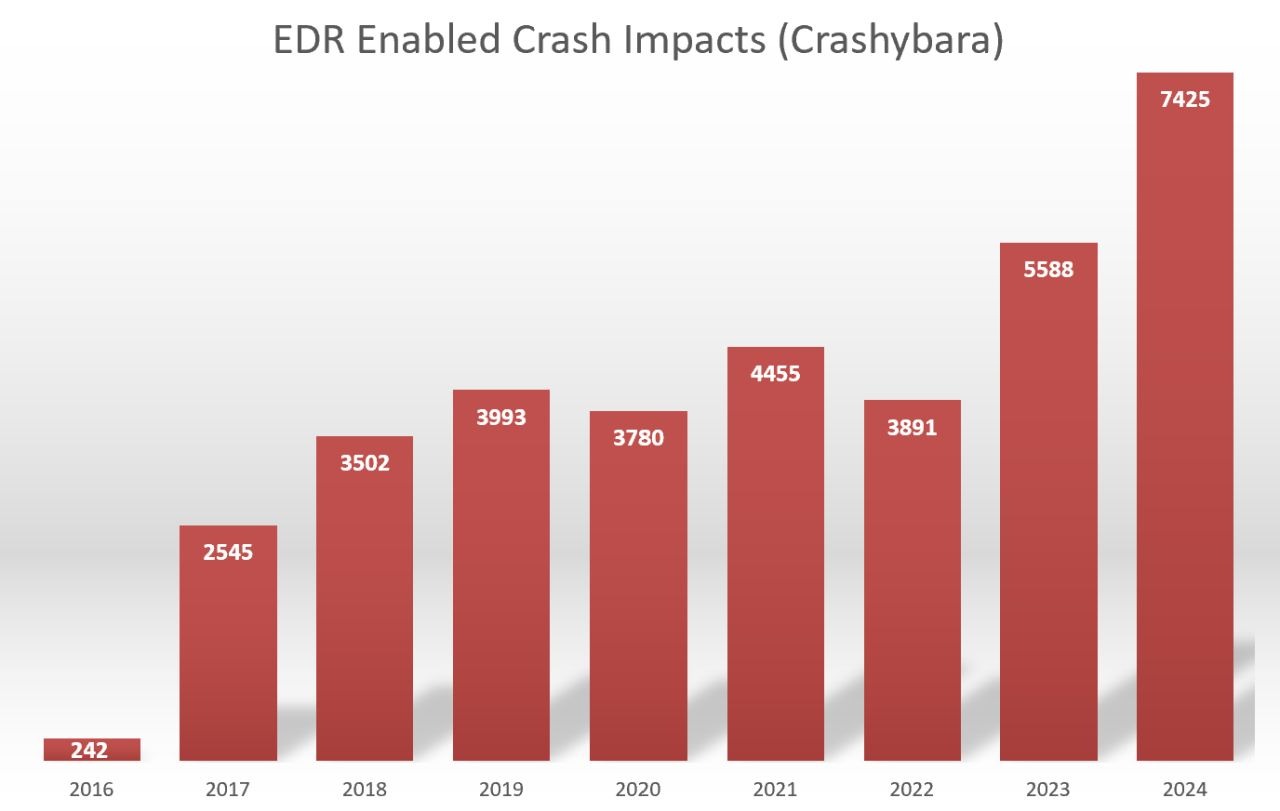
Figure 3: Number of EDR-enabled impacts added to CISS annually.
The result should be a much larger pool of useful crashes. And as that pool grows, we can become increasingly selective about the crashes we use. We can increasingly look for the same sister-year range, similar impact orientations, and similar collision partners.
That doesn’t make CISS a replacement for traditional reconstruction techniques. It is one tool in the toolchest.
Crush analysis, photogrammetry, videogrammetry, crash simulation, physical evidence, vehicle inspections, and other reconstruction methods remain essential for developing and validating an opinion. CISS comparisons provide another source of real-world data that can be considered alongside those methods.
What is changing is the quality and quantity of real-world crash data available to us.
As CISS continues to expand, I think we’re only beginning to see how useful that data can become.
If you’d like to try Crashybara, get your first month free on any subscription at checkout with code FALL26. Offer good through the end of October.